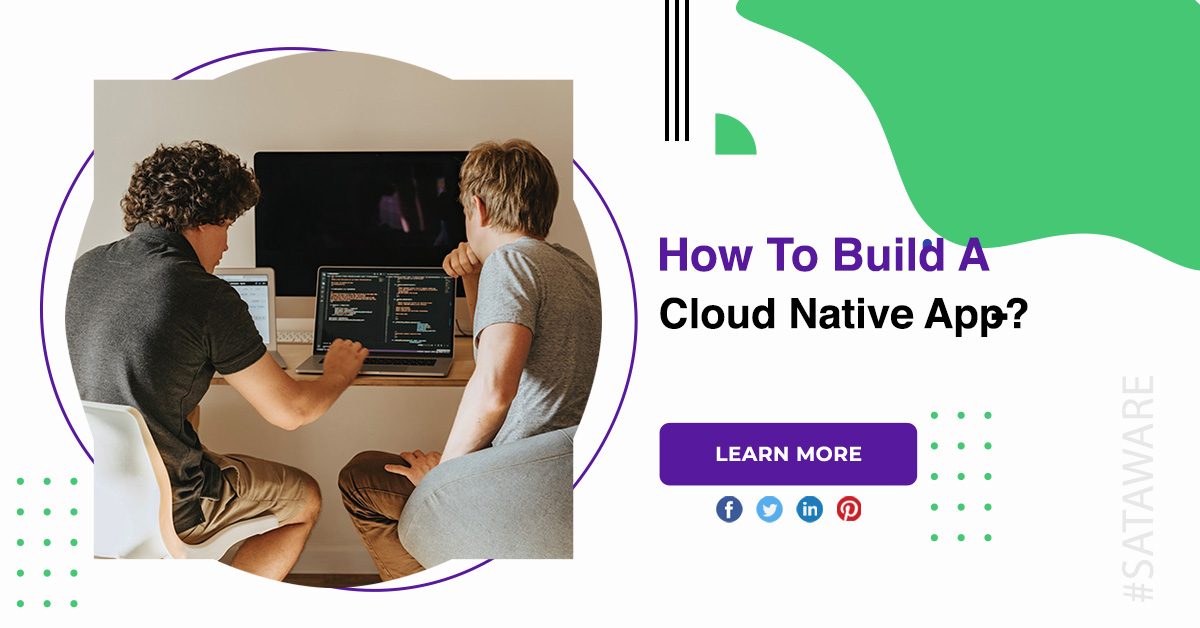
How To Build A Cloud Native App?
Applications that are developed and deployed using cloud-based technologies are known as Cloud Native Applications. They are hosted and managed by the cloud. It is built, tested, deployed, and managed in the cloud. In other words, it is run from end to end in the cloud. These applications exploit the advantages of the cloud computing delivery model.
Cloud native app benefits
Faster release
The faster an organization can conceive, build, and ship value to customers, the more likely it will succeed. Using DevOps, they transform the software delivery pipeline using automation, building automation, test automation, or deploy automation. Cloud-native applications support DevOps process and automation, which is not possible in local development processes and limited server-based software developer processes.
Ease of management
It helps to make infrastructure management effortless. Using serverless platforms like AWS Lambda and Azure function, they don’t need to manage or worry about operating like configuring networking, allocating storage and provisioning cloud instances.
Reduced cost
Containers manage and secure applications independently of the infrastructure that supports them. Industries are using Kubernetes for containers. Kubernetes is an open-source platform that is standard for managing resources in the cloud. Its applications are using containers; hence it fully benefits from containerization.
Reliable system
It helps to build applications that are fault-tolerant with self-healing built-in. Even when a failure occurs, we can easily isolate its impact. Hence, it does not impact the entire application and does not take down the entire application.
Avoid vendor lock-in
Enterprises are using an on-premise data center and at least one public cloud platform. Even the conversation among the cloud platforms has become graduated to enabling portability across clouds. we can never lock into a single vendor. They are making cloud-native applications that can run on any infrastructure such as public or private cloud without any changes.
Scalability
Auto scalability is the main feature of cloud-native applications. To handle future needs by default, applications will scale automatically.
Auto-provisioning
Cloud-native applications support auto-provisioning. They will automatically go for self-service and programmatic provisioning when they need some resources.
Conclusion
Enterprises are moving to the cloud very rapidly as it is providing more features to the user. Handling data, building applications, and providing services using the cloud is very easy. They are easy to manage, and it cost only on a use basis.









 Minnesota (HQ)
 Canada
 Australia
 India
India